
IOMP Webinar:
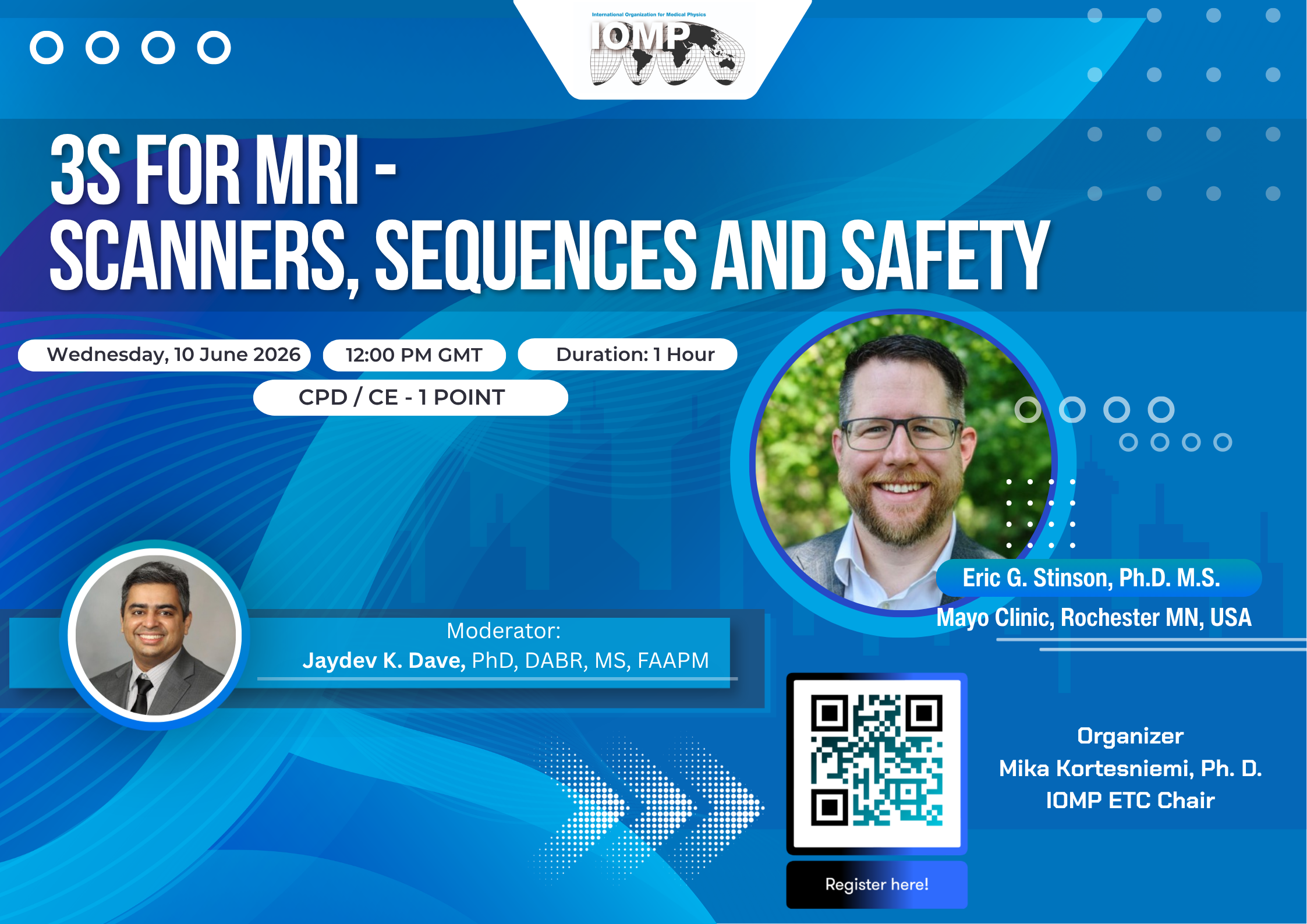
3S for MRI – Scanners, Sequences and Safety
Wednesday, 10 June 2026 at 12 pm GMT; Duration 1 hour
Organizer: Mika Kortesniemi, PhD, IOMP ETC Chair
Moderator: Jaydev K. Dave, PhD, DABR, MS, FAAPM
Speaker: Eric G. Stinson, Ph.D. M.S.

Eric G. Stinson, Ph.D. M.S. is an ABMP-certified MRI medical physicist at the Mayo Clinic in Rochester, MN, USA. Dr. Stinson received his master’s degree in medical physics from McGill (Montreal, QC, Canada) while working with Dr. G. Bruce Pike at the Brain Imaging Centre at the Montreal Neurological Institute. He then relocated to Rochester, MN to pursue a Ph.D. in biomedical engineering and physiology at Mayo Clinic where he worked with Dr. Stephen Riederer on improving the depiction of the vessel lumen in contrast-enhanced magnetic resonance angiography through advanced image reconstruction techniques. Dr. Stinson then worked in ultra-high field MRI for Siemens Healthineers for 4 years before returning to Mayo Clinic as a clinical MR medical physicist. Throughout his career, Dr. Stinson has been involved in many sides of MRI research including RF coil design and construction, diffusion imaging, highly accelerated time-resolved contrast-enhanced MR angiography, perfusion imaging, fat-water separated imaging, and ultra-high-field MR imaging. He also has a passion for education and lectures in the MRI technologist program in the Mayo Clinic School of Health Sciences and is a past organizer of the ISMRM Artifact Game Show.
Abstract:
This lecture provides a comprehensive overview of key concepts in Magnetic Resonance Imaging (MRI), focusing on the technology, image formation, and safety principles critical to clinical practice. We will explore the wide range of MRI scanner field strengths—from low‑field to ultra‑high‑field systems—highlighting their respective advantages, limitations, and clinical applications. The session then introduces the major categories of pulse sequences, including spin echo, gradient echo, and advanced fast-imaging techniques, emphasizing how sequence design influences tissue contrast and diagnostic utility. Finally, we will review key administrative controls that support MR safety, including screening procedures, zoning, staff training, and incident‑prevention strategies. By the end of this lecture, participants will gain a clearer understanding of how scanner characteristics, sequence selection, and robust safety practices work together to ensure high‑quality and safe MRI examinations.
Learning Objectives:
- Scanners: Identify the wide variety of field strengths in MRI and advantages and disadvantages of each
- Sequences: Understand the main types of pulse sequences and how they are used to produce differing contrast.
- Safety: Identify the administrative controls used to ensure MR safety.