INTERNATIONAL DAY OF MEDICAL PHYSICS (IDMP) 2026

IDMP 2026 Message by the IOMP President

Dear Colleagues and Friends,

On behalf of the International Organization for Medical Physics (IOMP), I welcome you to the International Day of Medical Physics (IDMP) on 7 November.

This year’s theme, “Advancing Global Health Equity: The Ethical Foundation of Medical Physics,” focuses on the responsibility of our profession to support fair access to safe and effective healthcare.

According to WHO (https://www.who.int/health-topics/health-equity#tab=tab_1): “Equity is the absence of unfair, avoidable or remediable differences among groups of people, whether those groups are defined socially, economically, demographically, or geographically or by other dimensions of inequality (e.g. sex, gender, ethnicity, disability, or sexual orientation). Health is a fundamental human right. Health equity is achieved when everyone can attain their full potential for health and well-being.”

In this aspect, medical physicists play an important role by ensuring quality and safety of medical technologies, supporting training and capacity building, and working with multidisciplinary clinical teams to improve patient care in all settings.

Contributing to health equity means applying our expertise where it is most needed, supporting consistent standards, and helping reduce gaps in access to healthcare between regions and populations, including developing novel and affordable point-of-care technologies that can be used in resource limited environments.

To mark this theme, IOMP has announced a poster competition, already receiving submissions from around the world. We are also preparing a special IDMP webinar in November relevant to the topic – so stay tuned for further announcements. And while we hope that you will participate in the IOMP activities, we also encourage all countries to organize their own activities and prepare presentations as part of the celebration.

We look forward to your active participation.

Eva Bezak
President, IOMP

IDMP 2026 Message by the IDMP Coordinator


Dear Medical Physicists from around the globe,

This year’s theme for the International Day of Medical Physics is:

“Advancing global health equity: The ethical foundation of medical physics”

As members of the International Organization for Medical Physics (IOMP), we recognize that advancing global health equity is not only a goal, but an ethical priority of the medical physics profession. Medical physicists play a vital role in ensuring safe and effective therapies, high-quality diagnostic imaging, adequate radiation protection, and help develop new emerging technologies. When there is inequitable access to quality medical physics services, this may lead to inequities in health outcomes.

Around the world, access to safe radiation therapy, diagnostic imaging, nuclear medicine, quality assurance programs, and trained medical physicists varies dramatically. In many countries, shortages of trained professionals, inadequate infrastructure, and limited regulatory frameworks may impact patient safety and limit access to new life-saving technologies.

Advancing global health equity requires, among others, that high-quality medical physics services are universally accessible, so that every patient can receive the highest possible standard of care.

As a global organisation, the IOMP has both influence and responsibility, and is uniquely positioned to work toward the global health equity by, for example:

  • Expanding accessible online education.
  • Fostering collaborations across borders.
  • Supporting regional training centres and mentorship programs.
  • Developing guidance on responsible adoption of advanced technologies.
  • Encouraging collaborative research and knowledge-sharing networks that reduce the global research gap.
  • Advocating data-driven transformation and deployment of automated, objective and standardised methods to expand medical physicist toolkit and make our work more accessible in modern healthcare.
  • Encouraging sustainable technology implementation by ensuring that any equipment donations or installations are accompanied by training, maintenance planning, and quality assurance systems.

As medical physicists, our work is often focused on patient safety, radiation protection, scientific integrity, and technological innovation. Let’s use this Internation Day of Medical Physics to remind ourselves of the importance of advancing global health equity, so we can ensure that every patient – regardless of geography, socioeconomic status, gender, or political context – has access to safe and high-quality medical physics services, so they can receive the best possible care.

As a part of the International Day of Medical Physics, we will be holding a poster competition, and we are very excited to see your visual interpretation of this year’s theme, stay tuned for the call to posters.

With many thanks,

Erato Stylianou Markidou and Stephen Tronchin

IDMP 2026 Coordinators

IDMP 2026 theme:

“Advancing Global Health Equity: The Ethical Foundation of Medical Physics”


Dear Colleagues,

We are delighted to share the official winning poster for the upcoming International Day of Medical Physics (IDMP) 2026, designed by Francesca Vittorini, Camilla Petrucci and the Health Physics Team, from the San Salvatore Hospital L’Aquila, Italy.

This inspiring design beautifully captures the theme of IDMP 2026, “Advancing Global Health Equity: The Ethical Foundation of Medical Physics.” The ascending staircase symbolises progress, access, and the shared journey toward more equitable healthcare for all. The diverse patient–professional interactions reflect compassion, inclusivity, and the human-centred role of medical physicists in supporting safe, effective, and ethical medical care worldwide.

Let us all celebrate this achievement and use this poster proudly in our hospitals, academic centers, and outreach activities this year.
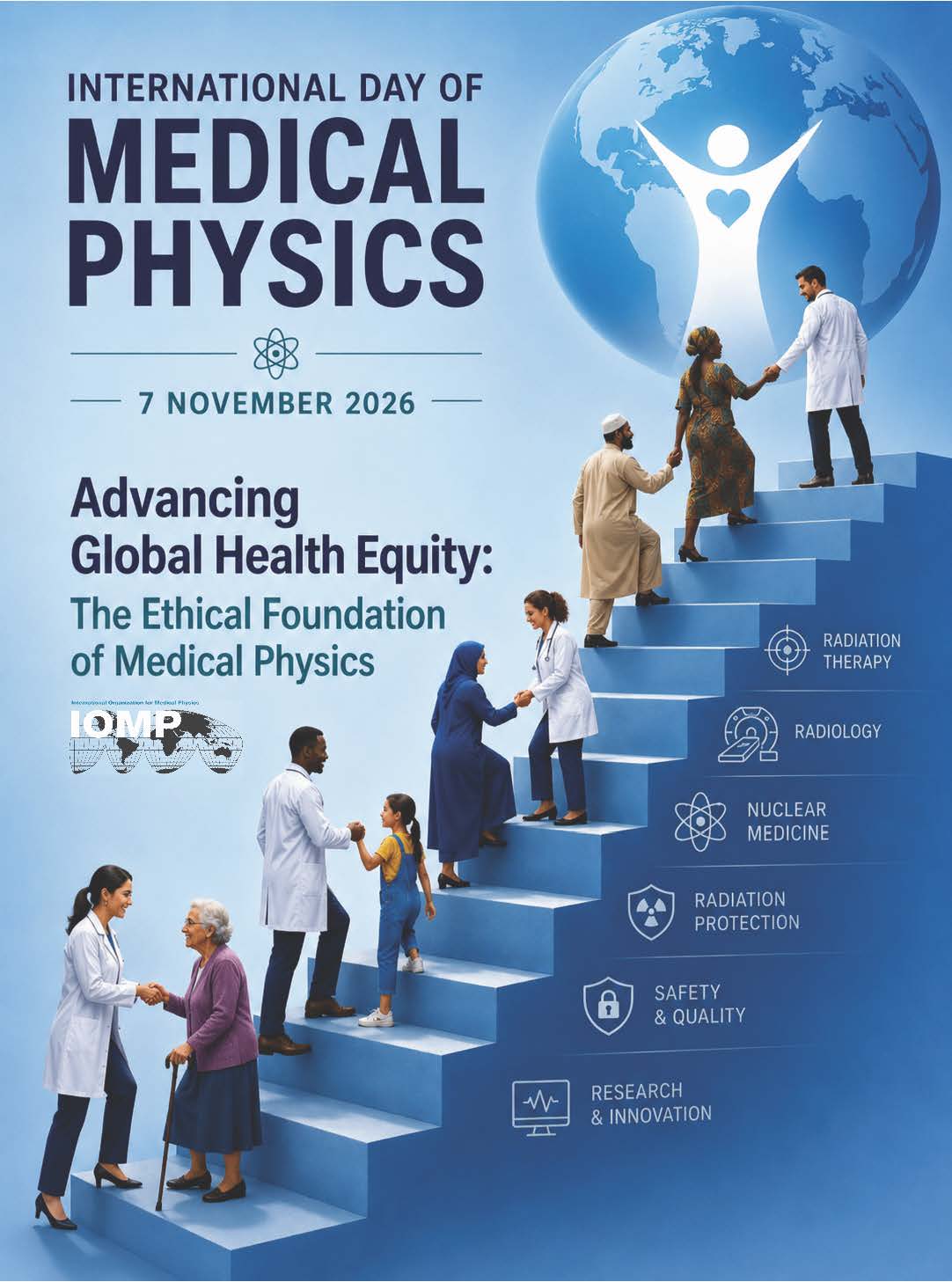
Download the poster (in PDF) here

📅  Registration Open — Upcoming
Nov
5
2026
IDMP 2026 — Advancing Global Health Equity: The Ethical Foundation of Medical Physics
Thu 5 Nov · 12:00 GMT · 3 speakers
▶ Advancing Global Health Equity through Safe and Quality-Assured Radiation Medicine — A WHO Perspective — Dr. Emilie van Deventer, WHO Geneva
▶ Innovation and Equity in Medical Physics — Dr. Meaghan Thumath, University of British Columbia
▶ Ethical Principles and Global Health Equity in Medical Physics Practice — Agnette Peralta, University of the Philippines
⌄
Date & time
Thu 5 November 2026 · 12:00 GMT
Duration
1 hour
Organizers
Eva Bezak & Magdalena Stoeva
Moderator
Eva Bezak, IOMP President
Talk 1
Advancing Global Health Equity through Safe and Quality-Assured Radiation Medicine — A WHO Perspective
Dr. Emilie van Deventer, PhD — Head of the Chemicals, Radiation and Health Unit, World Health Organization (WHO), Geneva, Switzerland
▼ Abstract
Medical imaging, radiotherapy, and nuclear medicine are essential components of modern health care and contribute significantly to the prevention, diagnosis, treatment, and monitoring of disease. Yet access to these services remains highly uneven across and within countries. Many low- and middle-income countries face major challenges, including limited infrastructure, shortages of trained personnel, insufficient quality assurance programmes, and weak regulatory and radiation safety frameworks. These gaps contribute to inequities in health outcomes and limit progress towards universal health coverage. Advancing health equity requires more than expanding access to technology. It also requires ensuring that radiation technologies are used safely, effectively, and sustainably, supported by appropriate governance, quality systems, and a competent workforce. Medical physicists play a critical role in achieving these objectives through their contributions to patient safety, quality assurance, radiation protection, workforce development, and innovation. This presentation will examine how strengthening access to safe and quality-assured imaging and radiotherapy services can support equitable health outcomes globally, and how medical physicists can contribute to implementing recent WHO priorities on medical imaging capacity, patient safety, and radiation and health.
▼ Speaker biography
Dr. Emilie van Deventer
Dr. Emilie van Deventer is Head of the Chemicals, Radiation and Health Unit at the World Health Organization (WHO) headquarters in Geneva, Switzerland. She leads WHO’s work on the public health aspects of ionizing and non-ionizing radiation, including radiation in medicine and radiation emergency preparedness and response, and provides guidance to Member States on radiation protection and health. She serves as the WHO representative to the International Commission on Non-Ionizing Radiation Protection (ICNIRP) and the International Commission on Radiological Protection (ICRP), and on various IAEA committees. Prior to joining WHO in 2000, she was a tenured Professor of Electrical and Computer Engineering at the University of Toronto, Canada. She holds a PhD from the University of Michigan, USA, and an honorary doctorate from the University of San Marcos, Lima, Peru.
Learning objectives:
  1. Describe key global inequities in access to radiation medicine services.
  2. Explain how safety, quality assurance, and workforce capacity contribute to health equity.
  3. Recognise the role of medical physicists in supporting safe, effective, and sustainable health services.
  4. Identify opportunities to contribute to WHO priorities on medical imaging, patient safety, and radiation and health.
Talk 2
Innovation and Equity in Medical Physics
Dr. Meaghan Thumath, DPhil, MScPH, RN — Assistant Professor, University of British Columbia, Canada
▼ Abstract
Innovation in health technology is transforming what is possible in diagnosis, treatment, and patient care. But technological progress does not automatically translate into health equity. As capabilities advance, an essential question remains: who benefits from innovation, and who is at risk of being left behind? Drawing on experience across public health systems, global health, humanitarian emergencies, and health policy, this presentation examines health equity as both an ethical foundation and a practical test of innovation. It explores how geography, poverty, gender, health-system capacity, workforce distribution, infrastructure, and institutional power shape whether technological advances translate into meaningful improvements in health. The presentation argues that equity must be considered across the full lifecycle of medical physics innovation — from priority setting and design to investment, implementation, quality assurance, evaluation, and access. For medical physicists, whose work sits at the intersection of science, technology, safety, and patient care, this creates a particular opportunity for leadership. Scientific excellence and equity need not be competing objectives: the challenge is to ensure that innovation is not only technically sophisticated, but accessible, safe, sustainable, and responsive to the populations we serve.
▼ Speaker biography
Dr. Meaghan Thumath
Dr. Meaghan Thumath, DPhil, MScPH, RN is an Assistant Professor at the University of British Columbia and a public health researcher and practitioner specialising in health equity, health systems, and global health security. A public health nurse by training, she has worked across clinical practice, research, government, and humanitarian response. For more than a decade, Dr. Thumath has provided technical assistance to the World Health Organization, the World Bank, the Global Fund, IFRC, national governments, and humanitarian organisations, supporting health-system strengthening and emergency response across more than 20 countries. Her international work has included responses to Ebola, COVID-19, and humanitarian emergencies across Africa, the Caribbean, Europe, and Asia. In Canada, she has held senior public health and government leadership roles in British Columbia and has advised on health policy, communicable disease control, substance use, and health equity. Her research examines how health systems can better respond to inequity, uncertainty, misinformation, and emergencies, with particular attention to trust, access, and the structural conditions that shape health outcomes.
Learning objectives:
  1. Explain why technological innovation does not necessarily produce equitable health outcomes.
  2. Identify structural factors that determine who benefits from health technologies and who may be excluded.
  3. Apply an equity lens across the lifecycle of innovation, from priority setting and design through implementation, quality assurance, evaluation, and access.
  4. Consider how medical physicists can incorporate equity, context, and social accountability alongside safety and technical excellence.
  5. Identify opportunities to advance innovations that are not only technically effective, but accessible, sustainable, and responsive to diverse health-system contexts.
Talk 3
Ethical Principles and Global Health Equity in Medical Physics Practice
Agnette Peralta, MS — Diagnostic Radiology Medical Physicist; Former Assistant Secretary of Health, Philippine Department of Health; Professorial Lecturer, University of Santo Tomas Graduate School
▼ Abstract
According to WHO, “health is a fundamental human right and health equity is achieved when everyone can attain their full potential for health and well-being.” The medical physicist, as “a physical scientist in medicine”, has a unique role because he/she has access to scientists, healthcare professionals, patients, and decision-makers in both government and private sectors. In this presentation, ethical principles such as beneficence, non-maleficence, and professional and scientific integrity that underpin the practice of medical physics will be discussed. Where these principles contribute to health equity both at the national and international level will be presented. An example is what has been done at the national level in the Philippines and Indonesia in ensuring radiation protection and quality assurance following the dictum “first do no harm”. There is a shortage of medical physicists in these two countries. In the Philippines, a private company composed of medical physicists provides acceptance/compliance and quality assurance testing for radiology facilities nationwide. A medical physics company within the University of Indonesia provides a similar service. These two companies employ graduate students in medical physics to help them fund their studies at the same time giving them valuable training. Another example is Thailand, where medical physicists from other South East Asian countries are accepted for clinical training with no training fee required, as a way of contributing toward global health equity. Other examples will also be presented.
▼ Speaker biography
Agnette Peralta
Agnette Peralta is a diagnostic radiology medical physicist who started her career in the Philippine Department of Health as a health physicist and retired as an Assistant Secretary of Health. She has a BS Physics degree from the University of the Philippines and an MS Medical Physics degree from the University of Wisconsin–Madison. She is currently a Professorial Lecturer at the University of Santo Tomas Graduate School Medical Physics programme where she has taught part-time since 1983. She also currently serves as a medical physics consultant for three healthcare establishments.
Learning objectives:
  1. Understand the ethical principles that underpin the practice of medical physics.
  2. Be aware of past and existing initiatives of medical physicists in support of health equity at the national and global levels.